
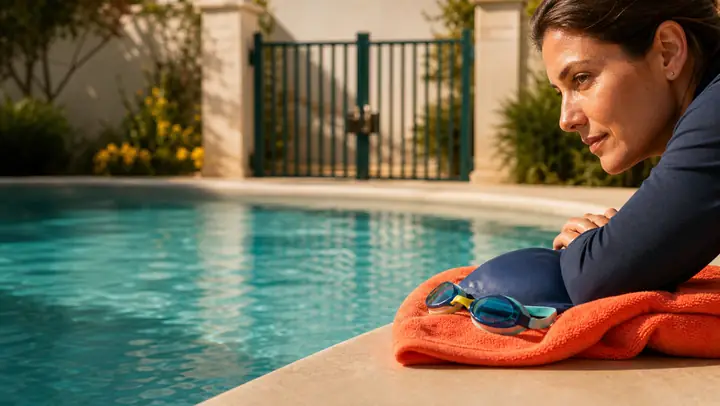
Child water safety does not depend on one tip, one device or one class. It is a system: supervision, blocked access to water, age-appropriate skills, equipment that does not create false confidence, and a clear emergency plan.
Why drowning looks different from what parents imagine
In movies, drowning is dramatic: hands in the air, shouting, splashing, an adult instantly realizing something is wrong. Real drowning is usually quieter. A child who is struggling for air cannot always call for help. The mouth and nose are busy trying to breathe. The arms are often trying to press down on the water, not wave for attention.
That does not mean parents should try to clinically diagnose drowning from a checklist. It means you do not wait for drama. If a child in the water is unusually quiet, vertical, not responding, not making progress, or simply looks wrong, you move closer immediately. The cost of checking too early is tiny. The cost of waiting is not.
How big is the problem?
Globally, the World Health Organization estimates around 300,000 drowning deaths every year. Almost a quarter of those deaths are in children under 5. That number includes very different countries and settings, so it should not be copied directly into the Israeli context. But it does show that drowning is not a marginal risk around children.
The US Centers for Disease Control and Prevention describes drowning as a leading cause of death for children. For children ages 1 to 4 in the US, it is the leading cause of unintentional injury death. In Israel, a registry study based on Ministry of Health data described 2,101 pediatric drowning cases from 2010 to 2022, with 189 deaths. That is about 9 percent of the recorded drowning cases, not a personal risk estimate for every pool visit.
This distinction matters. We use global numbers as context, US numbers where they are clearly labeled, and Israeli data when the source is specific and current enough. One claim was deliberately left out: a current 2026 annual death count attributed to Beterem. We did not verify a live Israeli source for it, so it does not belong in a publishable guide.
Findings in numbers
Water safety findings in numbers
300,000
annual drowning deaths worldwide
Source: World Health Organization
Ready to make your next step in the water feel manageable?
Leave your details and we will help you choose a calm, practical starting point.
Thank you — we received your details and will be in touch within one business day.
5 layers
supervision, barriers, skills, equipment, emergency response
Source: American Academy of Pediatrics
Silent
a drowning child may not shout or wave
Source: Beterem and Ministry of Health
2 minutes
possible loss of consciousness described by Beterem
Source: Beterem
2,101
Israeli pediatric drowning cases from 2010 to 2022
Source: Israeli registry study
~88%
relative reduction estimate from one observational study
Source: Case-control study
Age 4
Israeli Ministry of Health starting-age recommendation
Source: Ministry of Health
2x
non-fatal drownings vs deaths in CDC US data
Source: CDC
The cards below summarize the evidence boundaries: global drowning scale, the layered-prevention model, silent drowning, the speed of the event, Israeli registry data, what swim lessons can and cannot prove, the Israeli age-4 recommendation, and the difference between fatal and non-fatal drowning.
Age-risk map
Water safety changes with age, but not in a simple straight line. An older child is not automatically safe. The risks simply change. Babies face household water risks. Toddlers can reach water without permission. Preschoolers may be ready for formal lessons but still need close supervision. School-age children often gain skill before they gain judgment. Tweens want independence and need clear rules, not vague warnings.
Birth to age 1
A baby cannot protect themselves in water. The main risk is shallow water at home: a bathtub, bucket, basin, inflatable pool or any container with standing water. The Israeli Ministry of Health warns that danger exists even around 10 centimeters of water. The rule is simple: if the adult leaves, the baby leaves the water too.
Baby swim classes can be a positive experience. They can help adaptation, parent-child connection and calm exposure. They should not be sold as drowning prevention. The evidence for safety benefit in babies under 36 months is still emerging.
Ages 1 to 3
This is the age when risk rises sharply. The child moves, explores, climbs and has no mature sense of danger. A toddler can reach a pool before an adult realizes they have left the room. That is why access control matters as much as supervision.
Lessons can start to matter here, but only as one layer. The American Academy of Pediatrics treats lessons from around age 1 as a possible protective layer when the child is ready and the program is appropriate. A good class teaches exit, wall-holding, comfort with water on the face, and respect for water. It does not sell immunity.
Ages 4 to 6
The Israeli Ministry of Health gives a clear local anchor: children are recommended to learn swimming from age 4, according to the child’s ability. This does not mean every 4-year-old is automatically ready. It means this is the age when many children can start learning real water skills in a structured way.
At this age, the biggest parental mistake is overconfidence. A child can do a few laps and still not know how to respond when tired, surprised or pushed. Skill reduces risk. It does not erase it.
Ages 7 to 9
School-age children often look independent in the water. They jump, dive, compete and laugh. The risk shifts from basic movement to judgment. A child who swims well in a pool can still panic in the sea, misread depth, follow friends into a bad decision, or keep playing when exhausted.
The goal is not only better strokes. It is water responsibility: no entering without permission, no pushing, no holding another child under water, no breath-holding games, no jumping before checking depth, and no treating the sea like a larger pool.
Ages 10 to 12
At this age children ask for real independence. They want to go to the pool with friends, swim farther from adults, join pool parties and make their own choices. The safety tool is a clear contract, not “be careful.” Define where they may enter, who the responsible adult is, what happens if someone gets tired, and why even a strong swimmer does not enter the sea without an active lifeguard.
The first protection layer: real supervision
Real supervision is not general presence. It is an action. An adult sitting near the pool with a phone is not watching in the same way as an adult whose eyes are on the children. At pool parties, vacations and family gatherings, designate a water watcher for a short shift. During that shift, they do not use a phone, read, prepare food or split attention.
With babies and toddlers, supervision means arm’s reach. For older children, the distance can change with ability and setting, but responsibility does not disappear. The more noise, people and distractions there are, the more explicit the adult assignment needs to be.
The second layer: an environment that blocks unsupervised access
The hardest drowning to prevent in real time is the one that starts before anyone knows the child reached the water. A safe water environment starts before swimming begins. Around a home pool, the strongest professional standard is fencing that separates the pool from the house and yard, with a gate that self-closes and self-latches.
For inflatable pools, buckets and basins, the rule is empty after use. Standing water in a yard is not harmless. For bathtime, prepare the towel, clothes and soap before the child enters the water. If something is missing, take the child out first.
Swim lessons: important layer, not a charm
It is easy to oversell swim lessons. On one hand, formal lessons and water-safety skill training can reduce risk. A key case-control study found that in the drowning group, 2 of 61 children had a history of formal lessons, compared with 35 of 134 controls. For ages 1 to 4, the model produced an odds ratio of 0.12, often described as an approximate 88 percent relative risk reduction.
On the other hand, this was observational research, not a randomized trial. The confidence interval was wide. Recent reviews use careful language: training may reduce drowning mortality, but program quality, age, country and setting matter. Responsible wording is clear: good swim lessons are a meaningful layer, not a replacement for supervision, barriers, lifeguards, life jackets or judgment.
Pool, sea and bathtub are three different environments
When a parent says “my child can swim,” the next question is: where? In a warm pool with clear water and a wall nearby? In a crowded public pool? In the sea, with waves, currents, noise, sand, fatigue and changing depth?
Open water adds variables a child may not know how to read. The simple Israeli rule is to enter the sea only at a declared beach during active lifeguard hours. With children, “the water looks calm” is not a safety plan. A lifeguard is a public protection layer, not a personal babysitter.
Equipment and myths
Equipment can help. It can also mislead. A properly fitted life jacket in open water is a serious layer of protection. Arm floaties, rings, noodles and inflatable toys are not the same thing. They can slip, puncture, limit correct movement, and give both the child and the parent a false sense of safety.
That does not mean teaching aids are always bad. A good instructor may use flotation tools for gradual exposure or practice. The difference is purpose. A learning aid inside a supervised lesson is not the same as a safety device near water.
What to do when something goes wrong
This guide is not a CPR course and should not teach full resuscitation. But parents do need the basic order of thinking. If there is any suspicion of drowning or significant water inhalation, get the child out of the water, call for help, and involve emergency services according to the severity of the situation.
If the child is not responding or not breathing normally, begin emergency actions according to certified training and dispatcher instructions. If there is persistent coughing, abnormal breathing, confusion, unusual fatigue, vomiting, color change or behavior change after a water incident, seek medical evaluation. Do not decide alone that “it was nothing.”
Responsibility in Israel
In Israel, the Ministry of Health provides a current official source recommending swimming lessons from age 4, according to the child’s ability. Israeli sources such as the Ministry of Health and Beterem repeatedly emphasize supervision, shallow-water risk, silent drowning and safe water environments.
In public pools, camps and vacation settings, operators and staff also carry responsibilities. But the practical parental question is not who will be legally responsible after an incident. It is who sees the child right now. A lifeguard does not replace a parent. A camp form does not replace asking how supervision works.
Situation checklist
Before a bath: prepare everything in advance, never leave a baby or toddler alone in the water, and take the child out if you must leave.
Before a home pool: check the fence, check the gate, remove toys from the water, appoint a water watcher and make sure the child cannot access the pool independently.
Before a public pool: locate the lifeguard, check depths, set clear boundaries and do not let children enter before the adult is ready.
Before the sea: enter only at a declared beach during lifeguard hours, check flags and instructions, stay close, and do not chase objects that drift away.
Before a vacation or pool party: check access to water, hours of supervision, adult shifts and rules before the children are already excited and wet.
How to practice without creating false confidence
Parents often try to “do something” and accidentally mix safety, pressure and performance. A child who is scared of getting their face wet does not need a lecture about bravery. They need a small success. Practice should be narrow: bubbles, holding the wall, turning back to the wall, getting out of the pool. These skills look simple, but they change behavior.
Do not turn every pool visit into a test. If every moment in the water becomes correction and comparison, the child learns that water is a place where they are judged. Water should be calm, structured and respectful. Play with boundaries works better than pressure.
How to spot a class that does not sell illusion
A good swim class sounds like a process, not magic. Be careful with any program that promises a child will be “safe in water” after a fixed number of lessons, treats every child as the same, uses flotation as the main solution, or normalizes tears as proof of learning.
A serious instructor explains stages: water adaptation, basic skills, independent swimming, technique and endurance. They show you how the child enters, exits, responds to water on the face, finds the wall and copes when a drill fails. They do not only show you how far the child swam.
Where good parents slip
Most water-safety mistakes do not come from extreme neglect. They come from small assumptions: “I’m just grabbing a towel,” “he has floaties,” “there are lots of adults here,” “she already swims,” “the pool is shallow,” “the lifeguard sees.” Each sentence sounds reasonable in the moment. That is why it is dangerous.
The solution is not guilt. It is rules that do not depend on mood. No leaving the bath with a child in it. No pool entry without a named adult watching. No trusting floaties. No assuming a lifeguard replaces a parent. No older child supervising a younger child. No standing water left in the yard.
What this guide intentionally does not do
It does not teach CPR. A web article cannot replace hands-on training. It does not give medical advice after water inhalation. It does not interpret every legal requirement for every pool, camp or municipality. It does not promise that any specific class, method or age cancels risk.
It also does not use numbers we could not verify. If a statistic sounds compelling but lacks a clear current source, it stays out. Parents need a reliable map, not frightening numbers without support or reassuring promises without evidence.
The sentence every parent should remember
A child is safer in water when the adults around them behave as if no single layer is enough. Supervision alone is not enough, because adults get distracted. Fencing alone is not enough, because gates are left open. Lessons alone are not enough, because children get tired and scared. A life jacket alone is not enough, because equipment does not replace a person. A lifeguard alone is not enough, because they watch a whole pool.
But when the layers work together, risk drops. The child knows more. The adult sees more. The environment allows fewer mistakes. And the family does not have to rely on one perfect moment when everyone happened to notice in time.
How we checked
We checked this guide through three evidence layers. First, official sources: the World Health Organization, CDC, American Academy of Pediatrics, Israeli Ministry of Health, Beterem and Pool Safely. Second, research: Israeli registry data, the key case-control study on swimming lessons, reviews of water-safety skill training and literature on water-learning experiences. Third, wording: each numeric claim was mapped to a source, strong evidence was stated clearly, moderate evidence was hedged, and unverified claims were excluded.
Reviewer box
Before publication, this article was checked against four questions: does every number map to a verified source; are swim lessons framed as a layer rather than a guarantee; are Israeli, global and US numbers separated; and does the article avoid unsupported medical, legal or safety promises.